
Introduction
Artificial Intelligence is one of the fastest-growing technologies in the world, attracting hundreds of billions of dollars in investment from startups, venture capital firms, and global tech giants.
However, real-time financial data from 2025–2026 reveals a surprising truth:
Many core AI developers are still operating at heavy losses, despite generating billions in revenue.
The reason is simple but critical:
- Training advanced AI models costs enormous computing power and infrastructure
- Research and development spending is far higher than current earnings
- Several companies are valued based on future expectations rather than present profit
At the same time, large technology corporations integrating AI into existing businesses remain profitable overall, creating a split financial reality inside the AI industry.
To clearly understand this situation, let’s examine the latest comparative financial analysis.
Real-Time Financial Analysis Chart (2025–2026)
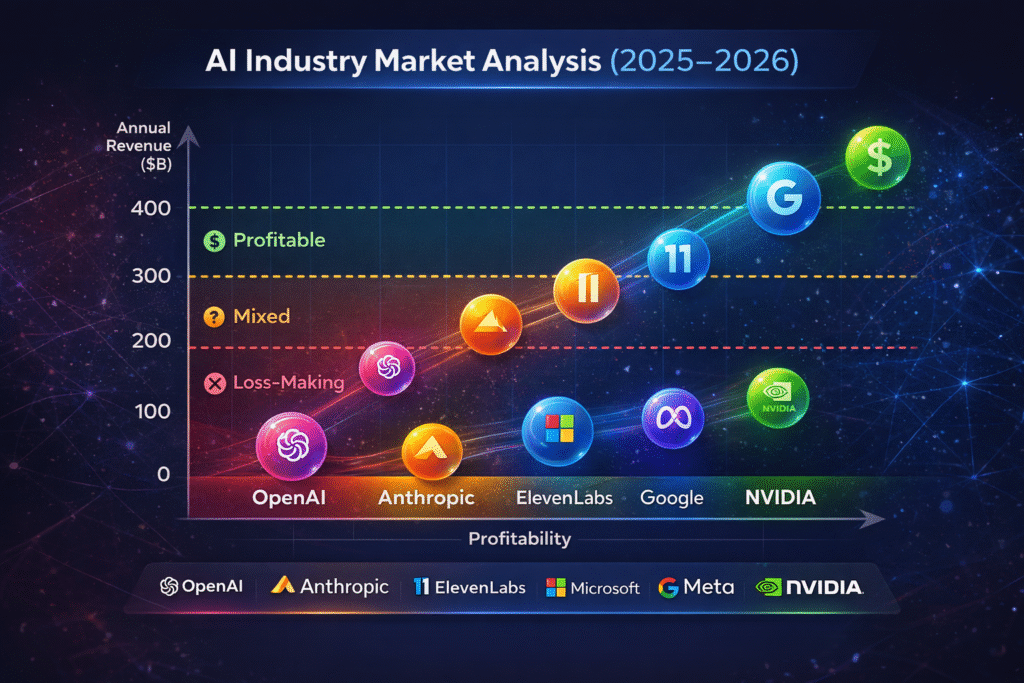
| Company / Category | Estimated Revenue | Profitability Status | Key Financial Insight |
|---|---|---|---|
| OpenAI | Multi-billion annual revenue | Not profitable | Extremely high compute and R&D costs |
| Anthropic & similar AI labs | Rapid revenue growth | Likely loss-making | Heavy dependence on investor funding |
| ElevenLabs & mid-size AI startups | Hundreds of millions ARR | Unclear / near breakeven | Scaling phase with high expenses |
| Google (Alphabet) | Hundreds of billions annual revenue | Highly profitable | AI integrated into ads, cloud, search |
| Microsoft | Hundreds of billions annual revenue | Highly profitable | AI boosts Azure and enterprise software |
| Meta | Tens of billions revenue per quarter | Profitable overall, AI units losing | Long-term AI infrastructure investment |
| Nvidia | Massive AI hardware revenue | Strongly profitable | Direct beneficiary of AI boom |
Why Many AI Companies Are Still in Loss
1. Extreme Infrastructure Costs
Training modern AI models requires:
- Massive data centers
- High-end GPUs
- Continuous electricity and cooling
- Large engineering teams
These costs can reach billions of dollars per year, making profitability difficult in the short term.
2. Revenue Models Are Still Developing
Most AI companies currently earn through:
- Subscriptions
- API usage
- Enterprise licensing
While revenue is growing fast, it is still smaller than total operating costs for pure AI research companies.
3. Investor-Driven Valuations
Many AI firms are valued based on:
- Future monopoly potential
- Expected automation impact
- Long-term productivity gains
This creates a gap where:
Valuation is very high, but real profit is still low or negative.
Why Big Tech Companies Are Still Profitable
Unlike pure AI labs, companies like:
- Microsoft
- Meta
already have existing billion-dollar businesses such as:
- Advertising
- Cloud computing
- Software ecosystems
AI acts as a revenue multiplier, not their only income source.
That is why they remain profitable even while spending heavily on AI.
The Key Turning Point: When Will AI Become Profitable?
AI profitability depends on three major shifts:
1. Lower Compute Costs
Cheaper chips and efficient models could dramatically reduce expenses.
2. Mass Enterprise Adoption
If businesses worldwide rely on AI daily, revenue could scale exponentially.
3. New AI-Native Industries
Automation, robotics, and AI agents may create entirely new trillion-dollar markets.
Future Prediction: Will AI Companies Eventually Make Real Profit?
The current financial picture shows short-term losses but long-term potential.
History provides a useful comparison:
- The internet boom of the early 2000s saw huge losses first
- Later, companies like Amazon and Google became massively profitable
AI appears to be following a similar trajectory.
Most Likely Scenario
- Short term (0–3 years):
Continued heavy spending and limited profitability for core AI labs. - Medium term (3–7 years):
Falling costs and rising enterprise demand may push leading AI firms toward sustainable profit. - Long term (7–15 years):
AI could become one of the largest revenue-generating industries in human history, rewarding the companies that survive the current investment phase.
Final Conclusion
So, are all AI companies losing money?
No.
- Pure AI research companies are mostly loss-making today.
- Large technology corporations using AI are already highly profitable.
This means the AI industry is not collapsing, but instead passing through a typical high-investment innovation phase.
The most realistic conclusion is:
AI losses today are likely the cost of building tomorrow’s trillion-dollar economy.
Thanks for this information.